
- The technology, explained
What is ice pigging?
A no-dig, no-chemical pipe cleaning technology that pumps a dense, soft ice slurry through your network — scouring biofilm, scale and sediment out in a single, controlled pass.
- In one sentence
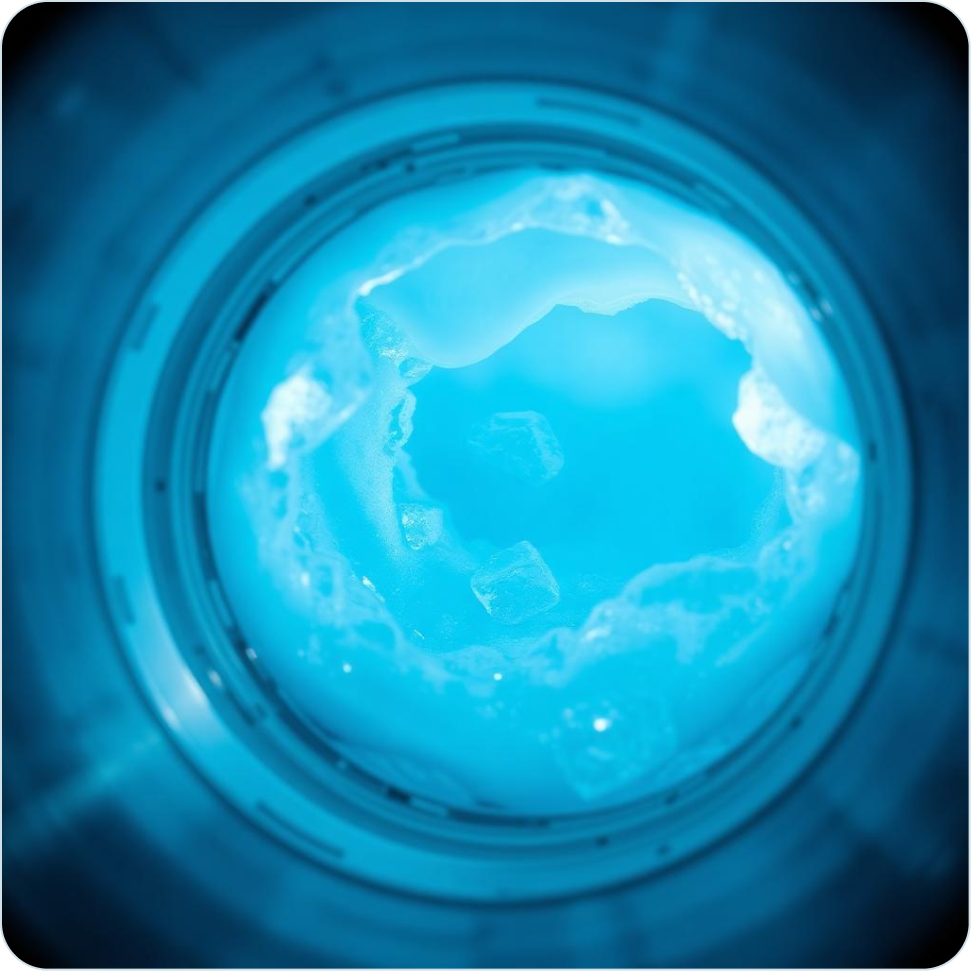
Ice pigging is the process of using pumpable ice as a soft, conformable pig to clean the inside of a pipeline.
Instead of a solid foam or polyurethane pig — which can get stuck, damage fittings, or skip past bends — ice pigging uses a thick slurry of crushed ice mixed with a freezing-point depressant. The slurry behaves like a liquid when it needs to (going around bends, through valves, past instrumentation) and behaves like a solid when it counts (scouring the pipe wall).
Originally developed at the University of Bristol, ice pigging is now used on potable water mains, sewer rising mains, food and beverage process lines, district heating circuits, and industrial pipework worldwide.

- The science
Why a slurry beats a solid pig — every time.
The cleaning performance comes from a few specific properties of an ice/brine mixture that no other cleaning method has all at once.
Two-phase fluid
Roughly 60–80% solid ice crystals suspended in chilled brine. The crystals do the scouring; the brine carries them through bends and fittings.
Shear at the wall
Where the slurry meets the pipe wall, ice particles generate high local shear — enough to dislodge biofilm and loose scale, but never enough to damage the pipe.
Self-clearing
If the slurry encounters a partial blockage or valve restriction, it simply melts — there is no risk of a stuck pig. The system stays controllable from end to end.
Concentrated waste
All the dislodged material exits in a small, concentrated discharge slug — typically a fraction of the volume that traditional flushing would produce.
- How it works
From survey to sign-off in a single shift.
A typical ice pigging operation runs end-to-end in 4–8 hours, with the pipe back in service the same day.
01
Survey & isolate
We map the section to be cleaned, identify a suitable injection point (typically a hydrant or tapping) and a discharge point, and isolate the run.
02
Produce the slurry
Ice is made on site (or delivered) and blended with a food-grade freezing-point depressant in our mobile rig until it reaches the right consistency.
03
Inject the pig
A measured slug of slurry — typically equal to 1–2× the pipe volume — is pumped in under controlled pressure behind a water push.
04
Scour & discharge
The slurry travels at line velocity, lifting biofilm and sediment off the wall. The dirty slug discharges through a hydrant or flush point into a tanker or to drain.
05
Verify & return to service
Turbidity, free chlorine, conductivity and bacteriology are sampled before the asset is signed back into service.
- Why operators choose it
Six things ice pigging does that nothing else does.
Can't get stuck
If anything goes wrong, the slurry melts. Period.
No excavation
Inject and discharge from existing hydrants, valves or taps.
1/20th the water
A short, dense slug replaces hours of flushing.
No chemicals
Just water, ice and a food-grade salt. Discharges to standard drainage.
Hours, not days
Most assets are back online the same shift.
Measurable result
Turbidity in the discharge slug proves how much was removed.
- Compared to alternatives
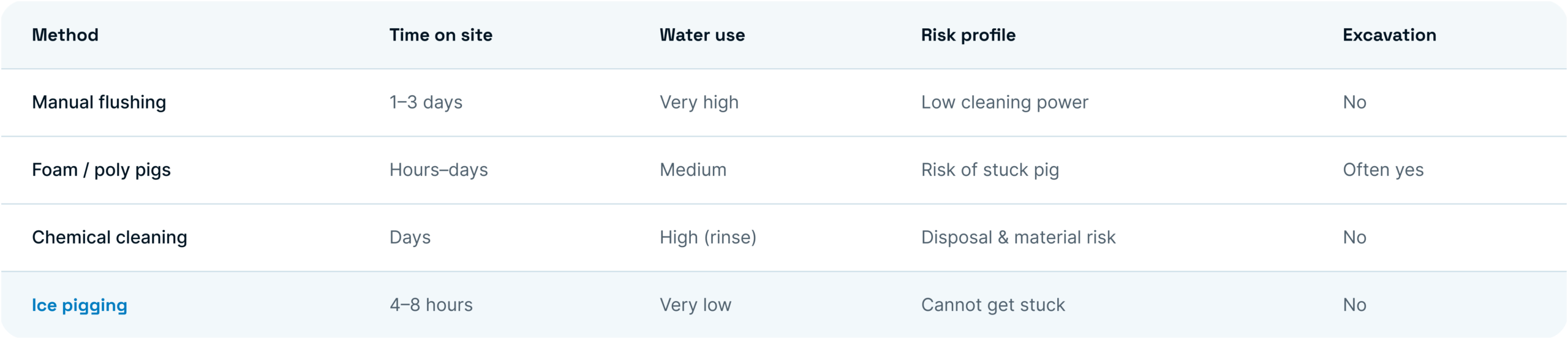
Where ice pigging fits in the cleaning toolkit.
Safe for potable assets
- Food-grade sodium chloride is the only additive — same salt used in food production.
- Discharge meets standard trade-effluent and drinking-water consents in most jurisdictions.
- No confined-space entry, no excavation, no road closures for typical jobs.
- Asset remains pressurised — no need to fully drain and recommission.
Built for sustainability targets
- Up to 95% less water than equivalent flushing programs.
- Zero process chemicals to handle, store or dispose of.
- Low embedded carbon: the ice is made and used on site.
- Concentrated discharge slug makes recovery and treatment easier.
- A short history
From university lab to global utility standard.
Early 2000s
Researchers at the University of Bristol’s Department of Mechanical Engineering investigate two-phase ice slurries for pipeline cleaning.
2010
First commercial deployments on UK water mains demonstrate a step- change reduction in flushing volumes and turbidity.
2015–2020
Adoption spreads across Europe, North America and Australasia for food and beverage changeovers and district heating networks.
Today
Ice pigging is specified by major water utilities, food manufacturers, refineries and energy operators worldwide — including the network PolarFlow operates.
- FAQ
Common questions, answered.
Is ice pigging safe for drinking water mains?
Could the ice get stuck in a pipe?
What pipe sizes and materials does it work on?
How long does the asset need to be offline?
What does the discharge look like?
How is it different from traditional pigging?
Have a more specific question about your asset? Send us a pipe schedule and we’ll give you a feasibility answer within 24 hours.
See ice pigging on your own pipework.
Book a no-obligation site walk and feasibility review. We’ll model the cleaning effect for one of your worst-performing sections.